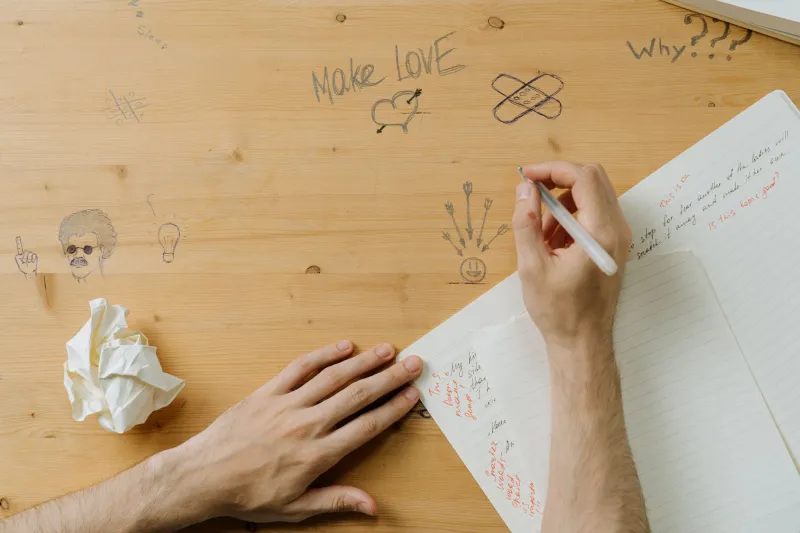
Somewhere on a hard drive — probably yours, definitely mine — there's a folder full of half-built things. A screenplay that stalled at page forty-seven. A song with a great first verse and nothing else. A painting that looked promising until it didn't. A business idea that never made it past the notes app.
We treat these things like failures. Evidence of our limitations. We hide them, delete them, or just quietly pretend they don't exist while we wait to have something finished to show the world.
I want to make the case that this instinct — however natural it feels — might be one of the most expensive mistakes a creative person can make.
The Finished Product Is a Lie (Sort Of)
Here's something that tends to get glossed over in conversations about creative work: the finished version of anything is a performance. It's the curated, edited, polished presentation of a process that was almost certainly messy, uncertain, and full of wrong turns.
That's not a criticism. That's just what finishing something looks like. You sand down the rough edges. You cut the parts that didn't work. You present the version of the thing that represents your best judgment about what it should be.
But in doing all that, you strip out something that a lot of audiences are genuinely hungry for: the evidence that a real human being made it.
In an entertainment landscape absolutely saturated with high-production content — Netflix originals, major label releases, studio-backed everything — the thing that's increasingly scarce isn't quality. It's authenticity. And nothing signals authenticity quite like showing the work before it's ready.
Why Process Content Hits Different
Look at what's actually breaking through on social media right now. It's not the polished brand campaigns. It's the writers posting voice memos of half-formed song ideas. It's the painters doing time-lapse videos of canvases that look terrible in the middle. It's the comedians workshopping jokes that bomb before they find the ones that land.
Taylor Swift's folklore documentary on Disney+ — in which she talked openly about writing songs in a matter of days, almost by accident — connected with fans on a level that a traditional album rollout never could have. Not because the music wasn't extraordinary, but because seeing the uncertainty behind it made the extraordinary feel accessible.
Or look at how much of Kanye West's cultural footprint came from open production sessions, unfinished leaks, and very public creative pivots. Love him or hate him, the chaos of his process became part of the mythology. People weren't just fans of the music — they were invested in the story of how it was getting made.
This isn't unique to music. Brandon Sanderson, one of the most commercially successful fantasy authors working today, built a massive YouTube following by doing live writing streams and detailed explanations of his drafting process. The audience wasn't just reading his books — they were watching him think. That's a fundamentally different and deeper relationship than a reader who just picks up a finished novel.
The Vulnerability Equation
There's a psychological reason this works, and it's worth understanding rather than just exploiting.
When you show finished work, you're asking an audience to evaluate it. When you show unfinished work, you're inviting them into it. Those are completely different propositions.
Evaluation creates distance. Invitation creates connection.
Unfinished work also does something that polished work can't: it makes the audience feel like collaborators. When someone watches you wrestle with a creative problem in real time, they start caring about the outcome in a way they never would have if you'd just handed them the solution. They've got skin in the game. They're rooting for you.
This is why so many Kickstarter and Patreon campaigns that show the messy process — the failed prototypes, the design pivots, the honest updates about what isn't working — outperform campaigns that present a clean, finished pitch. Backers aren't just buying a product. They're buying into a story they're now part of.
The Practical Case for Sharing Your Drafts
Beyond the emotional and psychological dimensions, there's a purely strategic argument for showing unfinished work.
First, it solves the content problem. Most creators struggle to produce enough material to maintain a consistent presence. But your creative process — if you're actually doing creative work — is generating raw material constantly. Notes, sketches, iterations, experiments. That's content you're already producing. You're just not sharing it.
Second, it creates feedback loops that improve the final work. Writers who share chapters-in-progress get reader responses that shape the finished manuscript. Musicians who post rough mixes hear from their community which direction to develop. This isn't compromise — it's information. The work often gets better because the creator stopped treating the process as a private matter.
Third, and maybe most importantly, it differentiates you in a way that finished work almost can't. Anyone can produce a polished final product. Only you can show your specific, idiosyncratic way of getting there. Your process is genuinely unique to you in a way that your output — which will inevitably be compared to everything else in its genre — might not be.
A Word About What to Actually Share
None of this means dumping every half-baked thought onto the internet without any curation. There's still an editorial judgment involved. The goal isn't chaos — it's considered vulnerability.
Share the rough draft when it reveals something true about the creative struggle. Show the failed experiment when the failure is instructive or relatable. Post the sketch when it captures an energy that the finished piece might lose. The question isn't is this ready? It's does this let someone in?
That's a different filter, and it opens up a lot more material than most creators realize they're sitting on.
What You're Actually Protecting When You Hide the Drafts
When we refuse to show unfinished work, we tell ourselves we're protecting our reputation. We don't want to be judged on something incomplete.
But I'd argue we're actually protecting our ego from a different kind of risk — the risk of being seen as someone who tries things and fails at them before figuring it out. Which is, of course, what every creative person actually is.
The hard drive full of unfinished projects isn't a record of your failures. It's a record of your ambition, your curiosity, and your willingness to attempt things you didn't know how to finish yet.
That's not something to hide. That's something worth sharing.
Start with one draft. See what happens.